
The month of May includes No Falls Week, which raises awareness of the risks of falls from height. Working at height remains one of the leading causes of serious injury and fatal accidents at work. Schools are encouraged to use No Falls Week as a prompt to review how tasks are planned, avoided where possible and controlled using the correct approach.
What is meant by working at height
Working at height includes any task where a fall could cause injury. This can include using ladders or steps, working on roofs, accessing high level areas, or working at or below ground level where there is a risk of falling.
Avoid working at height
The safest way to prevent falls is to avoid working at height altogether. Schools should always consider whether a task can be completed safely from the ground before planning any work at height.
Examples include:
- Using extendable or ‘wash and reach’ equipment
- Lowering displays or fixtures so they can be accessed from ground level
- Using long handled tools for cleaning or maintenance
- Carrying out visual inspections from the ground
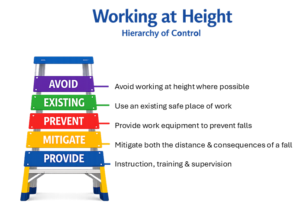
Working at height hierarchy
Where working at height cannot be avoided, schools must apply the working at height hierarchy in order:
- Avoid working at height wherever possible
- Prevent a fall by using a safe place of work or suitable access equipment
- Minimise the consequences of a fall where risk remains
Higher-level controls should always be considered before relying on lower level controls.
Planning and risk assessment
All working at height activities that cannot be avoided must be planned and risk assessed. The assessment should be proportionate to the task and consider who may be affected, including pupils, staff and visitors.
Repeated or higher risk tasks may indicate that a different method or a competent contractor should be used.
Ladders and stepladders
Ladders should only be used for short duration, low risk tasks where safer alternatives are not reasonably practicable. Schools must ensure ladders are suitable, checked before use, formally inspected at suitable intervals and taken out of use if damaged.
Using contractors
Higher risk, complex or specialist work at height should be carried out by competent contractors. Staff should not be expected to improvise or undertake tasks beyond their training or competence.
Training and competence
Anyone required to work at height must have appropriate awareness training. Additional task or equipment specific training may be required. Premises Managers should ensure staff understand both the risks and the controls.
Key messages for No Falls Week
- Avoid working at height wherever possible
- Always follow the working at height hierarchy
- Plan and risk assess work that cannot be avoided
- Use ladders only for short duration, low risk tasks
- Use competent contractors for higher risk work
- If in doubt, stop and seek advice
Learn more: